A Berkshire Boar has its fat marbled throughout which makes the meat so desirable!
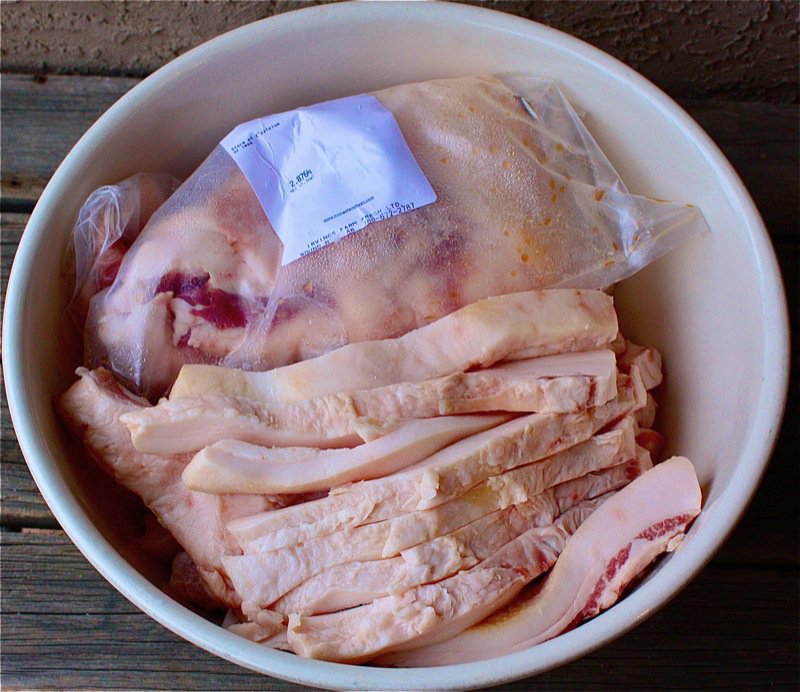
 The flavour of the fat is another reason this boar is so sought after. I bought ten pounds of back fat from Alan at Irving’s Farm Fresh (City Market downtown or OSFM) for $0.50 cents a pound. Yes. I got ten pounds of very tasty Berkshire Boar fat for $10.00. But, why?
 The primary reason was to confit an incredible Berkshire Boar Pork Belly (having just eaten some for dinner, I had to make my own) and I needed a truckload of the fat to do that just like you need a lot of duck fat when making duck confit. I did not want to buy manufactured lard. That thought made me a little ill. Rendering pork fat on my own was the solution.
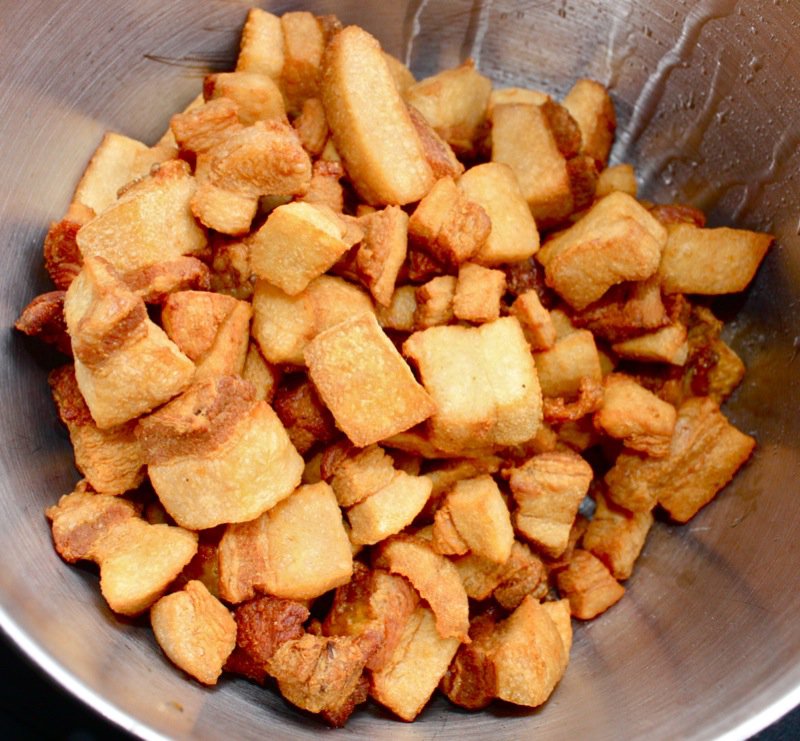
Vanja was beside himself when he saw this huge bag arrive in the kitchen. His family has raised and butchered many a pig, and he definitely knew how to render the fat. But, that is not why he was jubilant. It was because of the by-product created through the rendering process. The crispy cracklin’ tidbits that are fried into golden heaven when salt is added are called čvarci in his country and like candy to every child from the Balkans. Hungary, and maybe even the entire Eastern Block.
Because of the love for čvarci, the fat used for rendering pork fat is traditionally a bit meatier than what I got from Allan so meat is threaded throughout the cracklin’ bits. Vanja was disappointed there was such a little bit of meat. I wasn’t, but, in the future, I will ask for a “meatier” chunk of fat to please my partner who loves his country food and misses these kinds of treats in Canada. When our friend, V, saw we had made it, he also went nuts and he is a health fanatic. He only had four or five bites, but he was thrilled to have them.
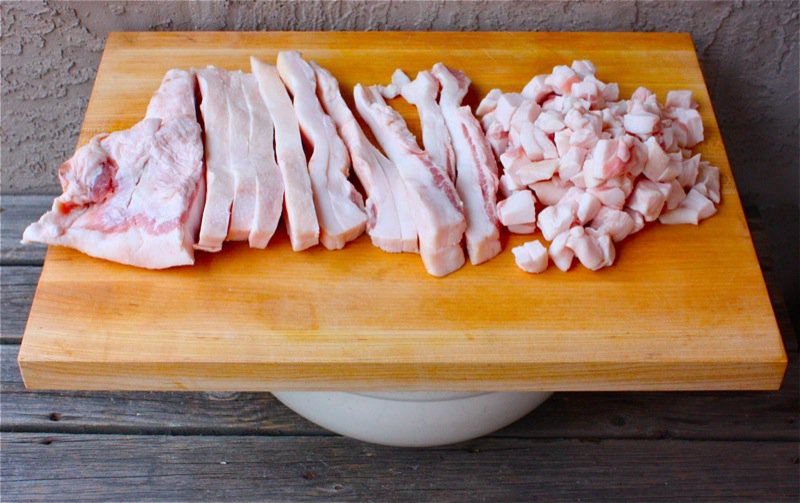
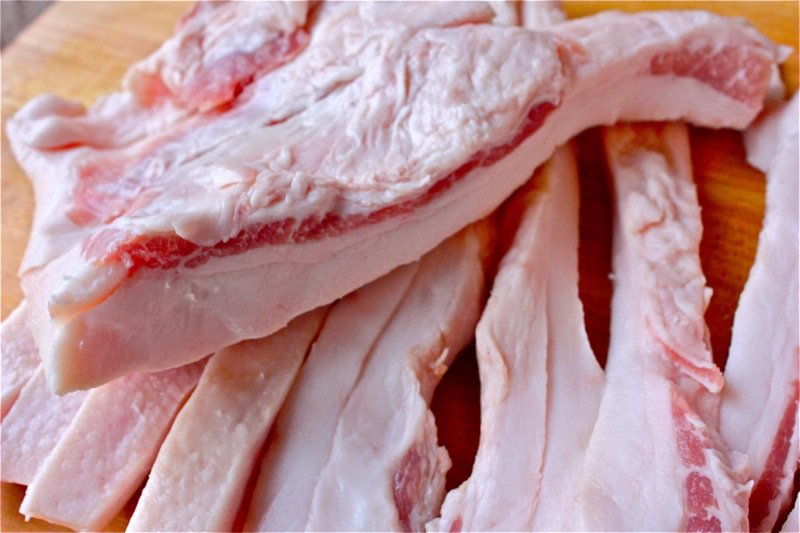
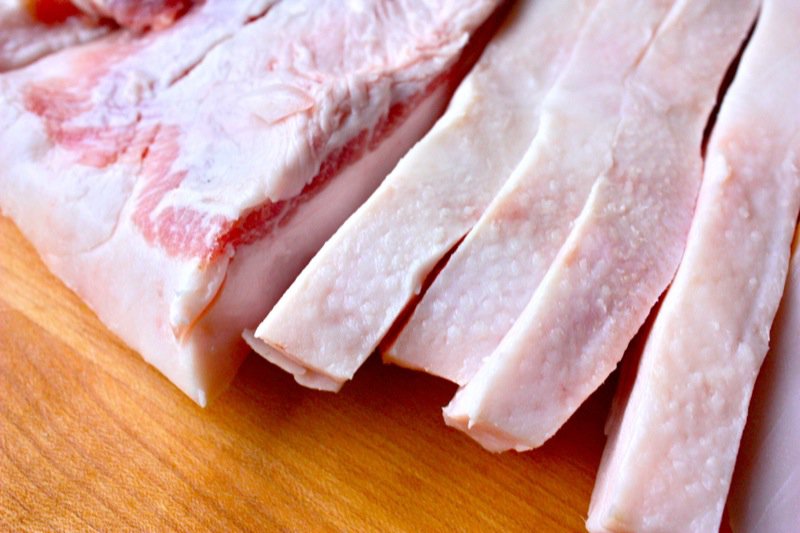
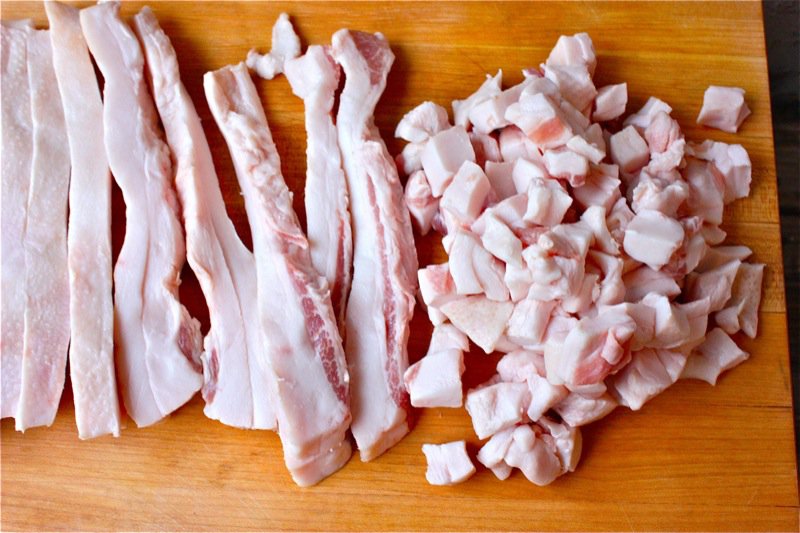
This is how Vanja cut the fat for rendering. We did one pan one night so I could learn how, and two pans the next night. I will do them all at once in my three heavy pans in the future. It took about an hour for rendering pork fat.
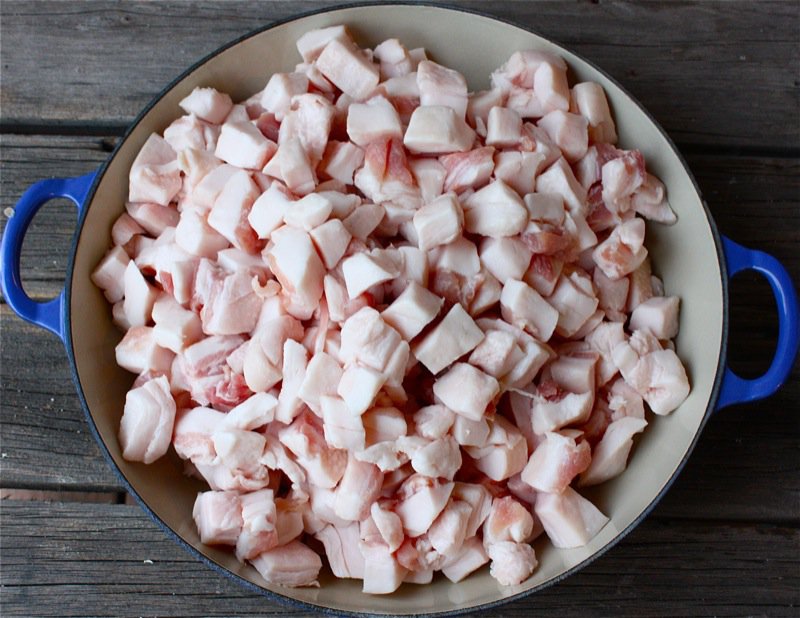
I started with the pan filled with the fat on my gas burner set to medium high heat and never left the side of the pan for a second in the beginning (about 10 minutes). I stirred every few minute (or seconds) to ensure that there was no sticking to the bottom of the pan, and no initial browning on the bottom of the pan. Once the fat started to melt, and there was a skiff of liquid fat that the bits were frying in, the heat was turned to medium and I stirred far less often. I even left the čvarci frying for 10-15 minutes at the end without stirring. The key is to not let any caramalization happen in the bottom of the pan, initially. The pieces will brown, but that will not colour the fat. If the pan browns, or if the pieces stick to the pan, that will colour and flavour the fat and we do not want that.
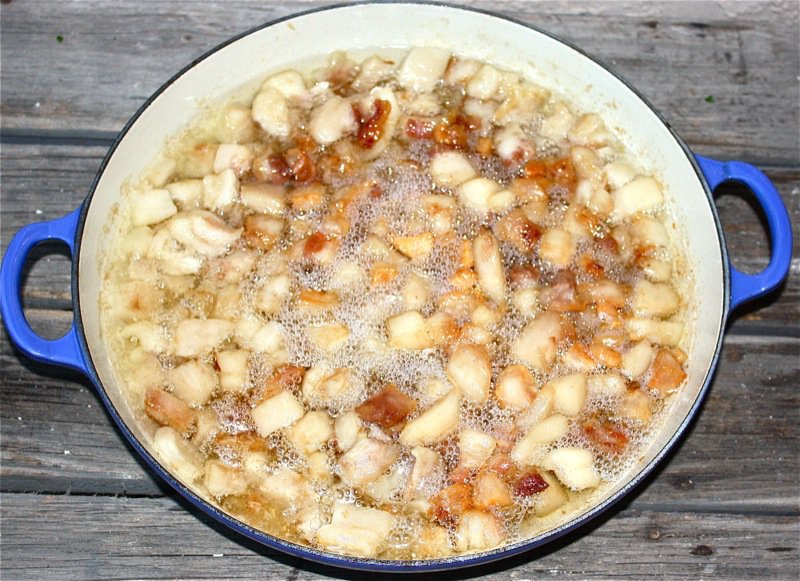
These are not quite ready., but they are close.
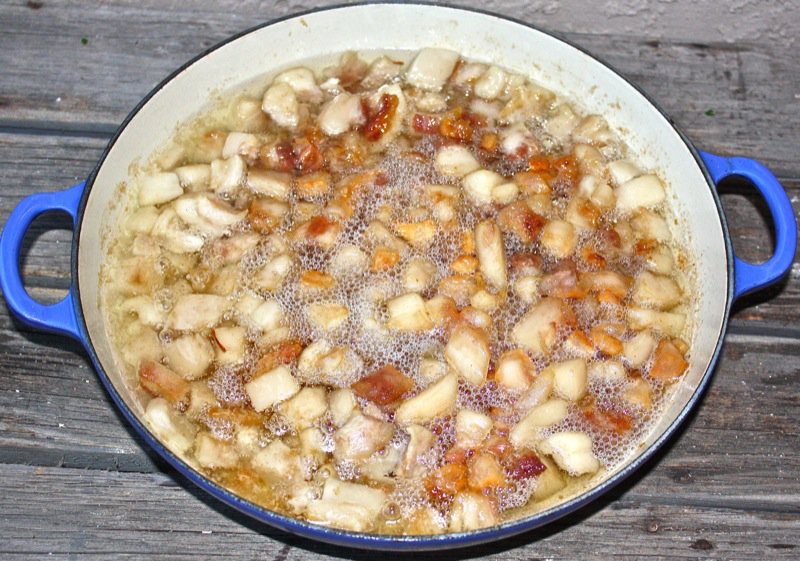
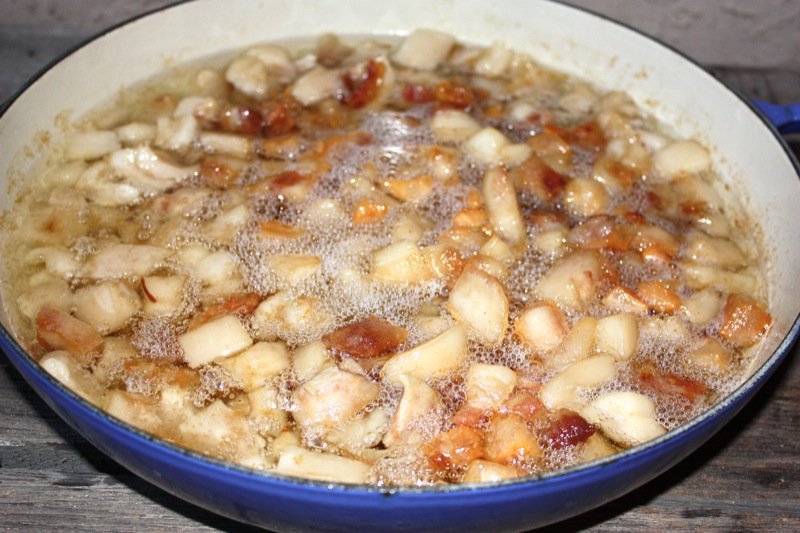
I was surprised how fast the process of rendering pork fat really was once it got started. It was not too messy, either, but we did the pouring outside. I have piled some of the pieces up for you to see, below. This pot is about half done.
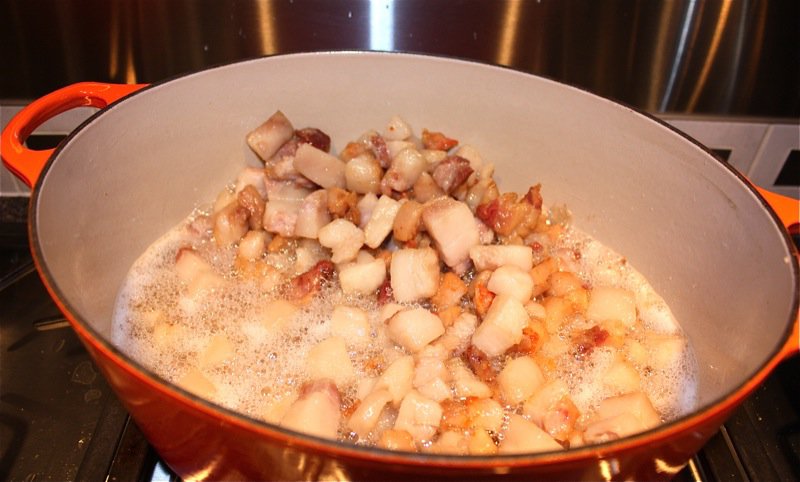
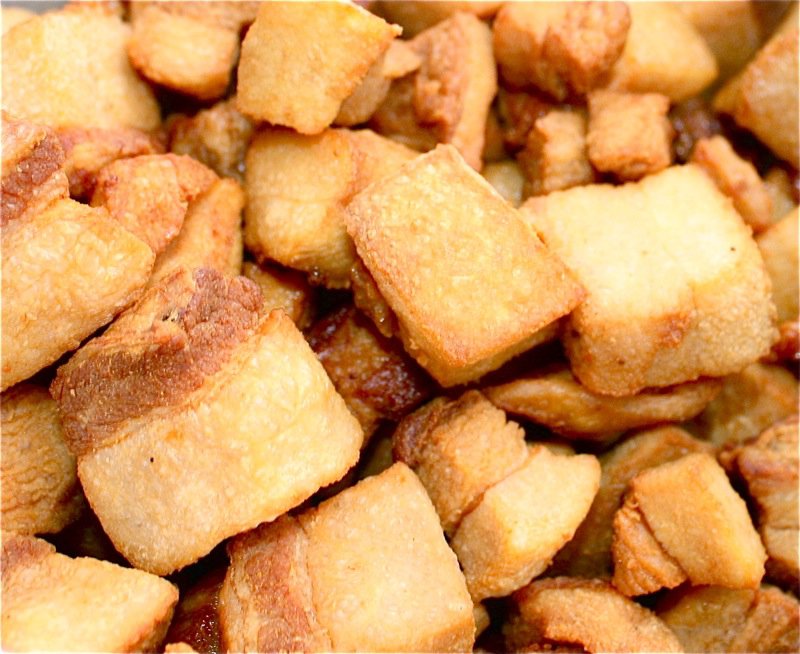
Below, the čvarci is done. You can see how lovely and golden the bits of fat finished rendering are. Vanja could barely wait for them to cool to try them.
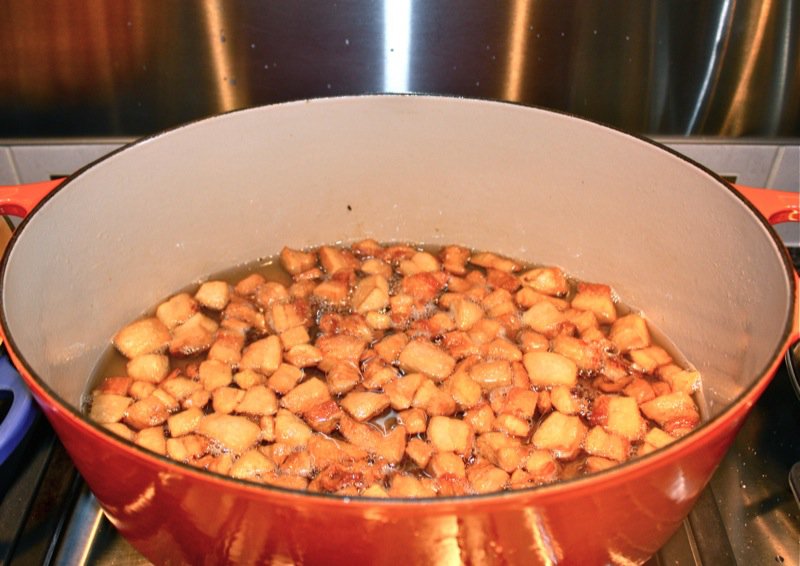
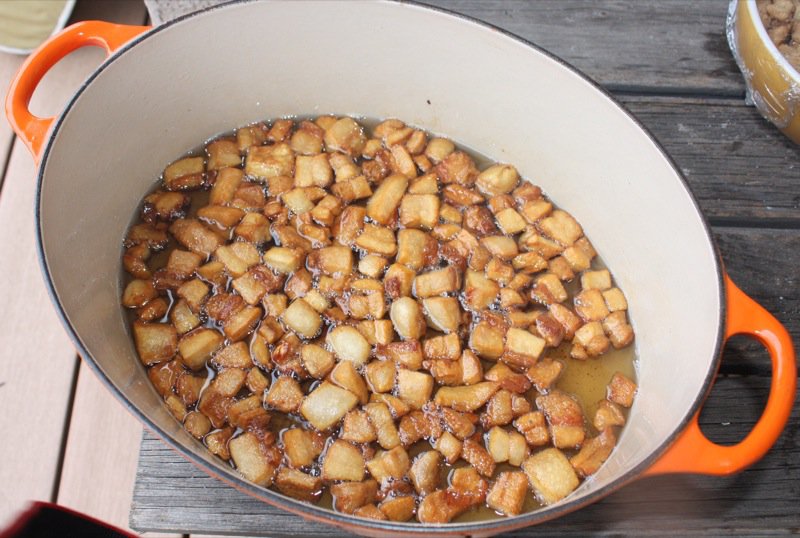
See how clear the fat is in the pot, below?
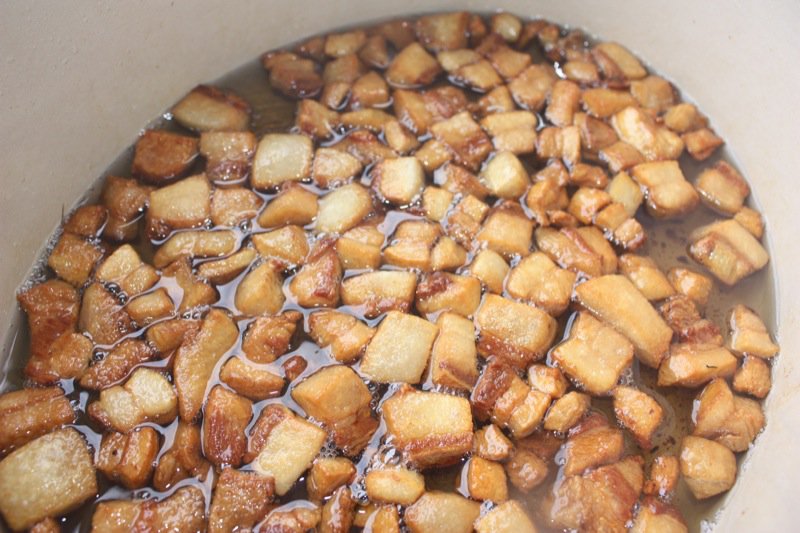
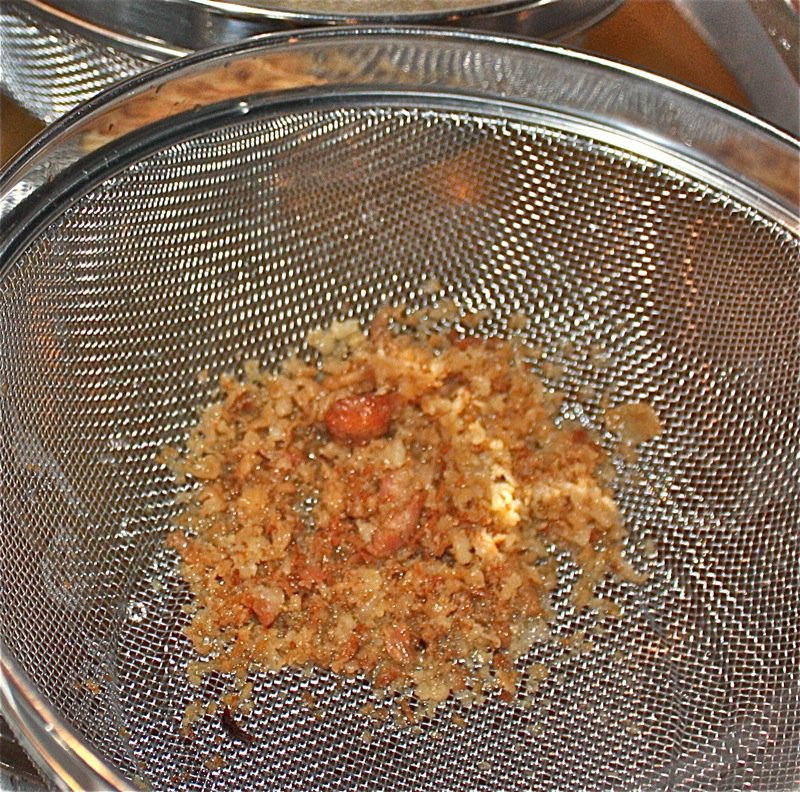
We scooped out the čvarci and strained the fat. Do you see the two bowls of čvarci below? Vanja made the colourless bowl. I fried the nice golden ones. Isn’t he a great teacher?
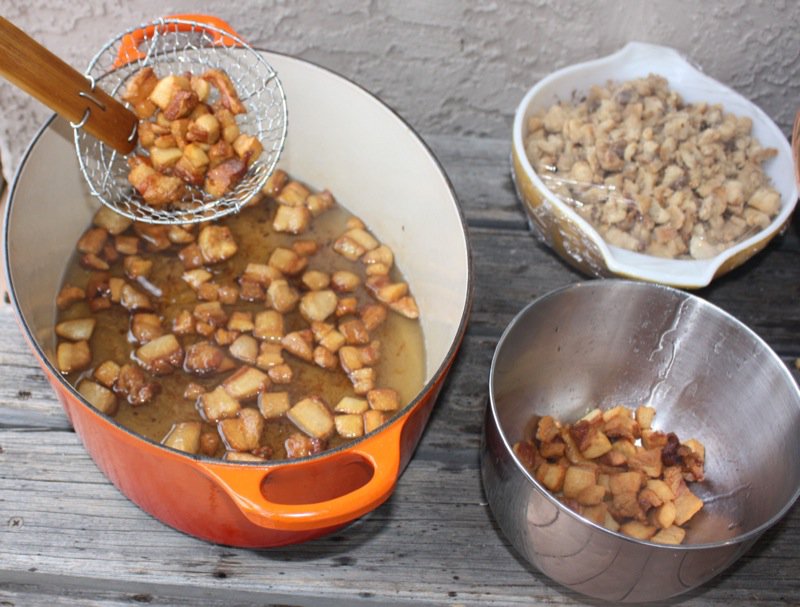
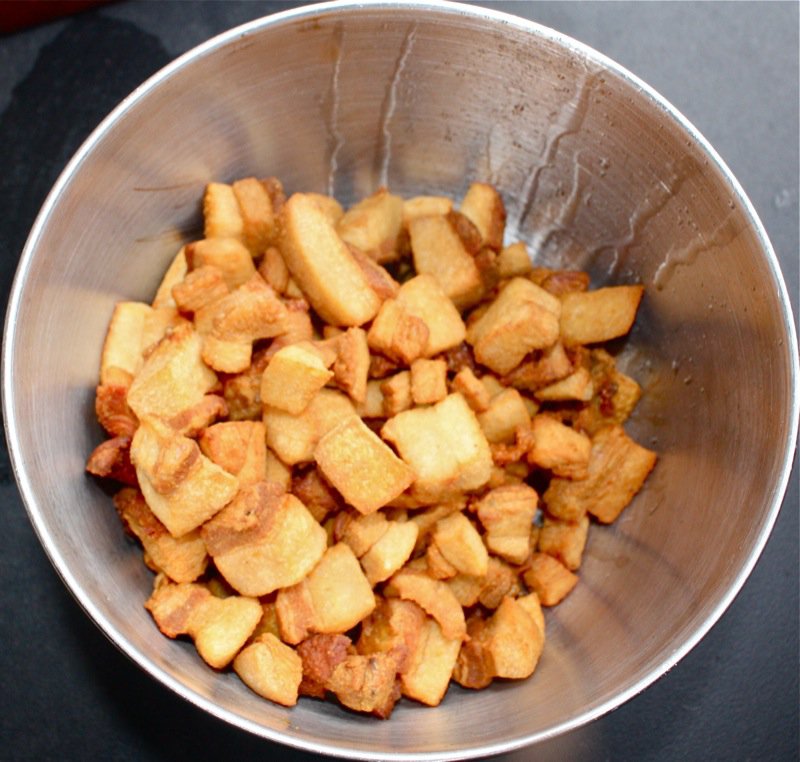
Can you smell those crunchy, fatty, flavourful little tidbits below? Yummers! I am usually repulsed by the oozing fat in these, but have actually had some really tasty ones with meat in them that were deadly delicious. However, for years, I was disgusted by them. Vanja always bought a little bag for himself whenever we went to the Budapest Deli. They are on the counter, there. That is how they came to be known as “crapola” at our house.
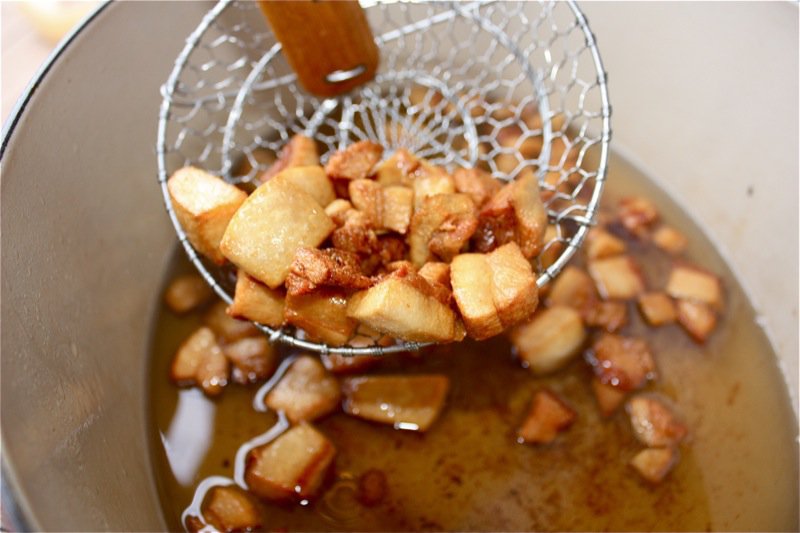
Waiting for the fat to cool a bit before straining it is a good idea.
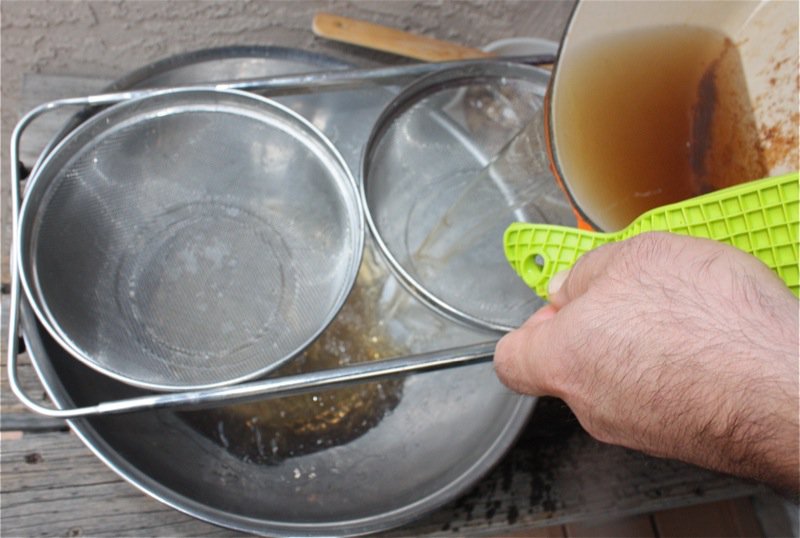
After it is strained, into the jars it goes. I like to keep my lard in jars as I find it easiest to use and store this way. Self rendered pork fat or pastry lard would most likely be better wrapped in parchment of kraft paper and stored in blocks similar to how it is sold to enable using the same recipes, me thinks.
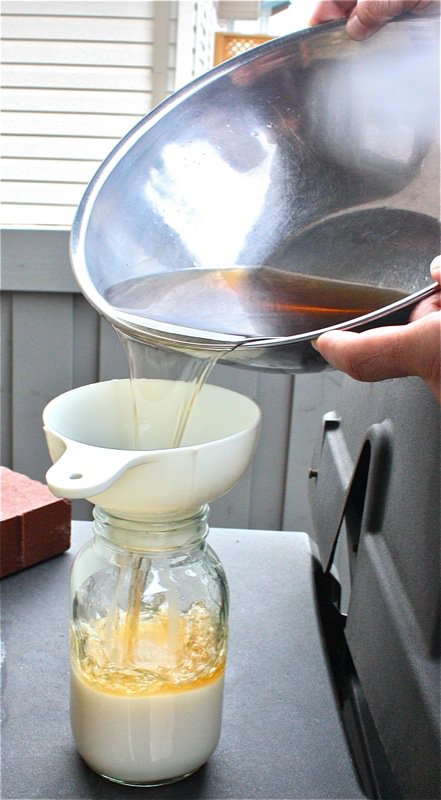
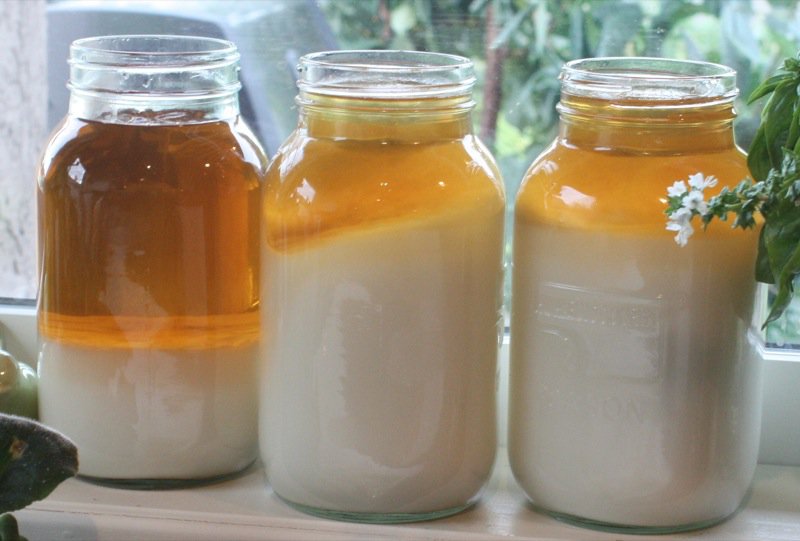
The reason there is some solid lard on the bottom of the jar is because I made a small amount the day before and I am adding to it now. Look at the beautiful clear fat.
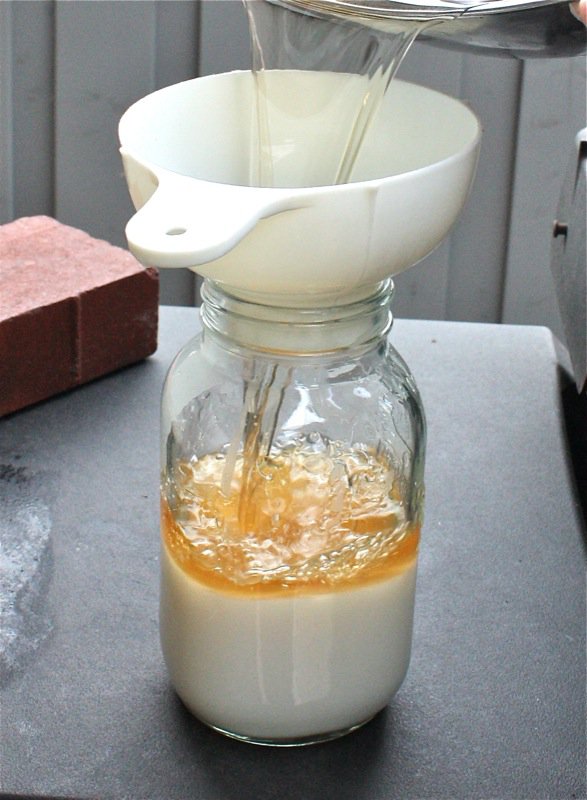
The first day, I was worried that it would not be white as the liquid fat was so golden, but it did turn into this beautiful white lard, below.
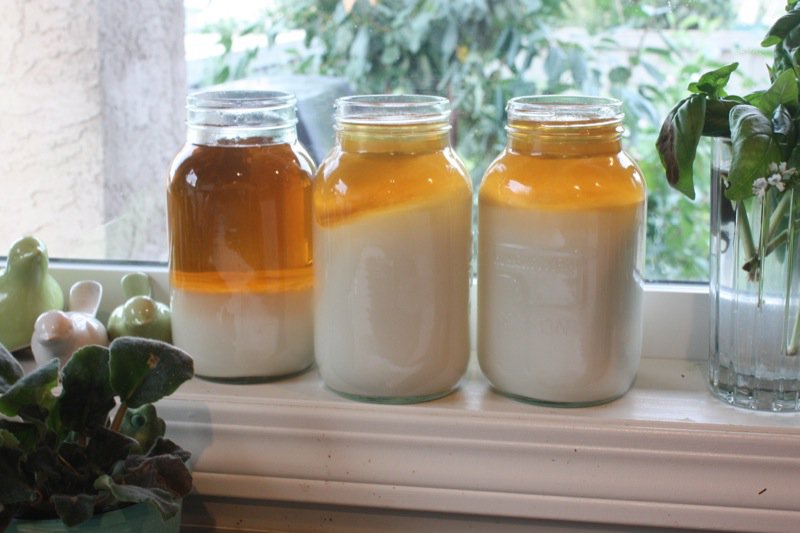
Ten pounds of the fat made three full litres of lard and a little more than a pound of čvarci. All that for five dollars is a steal of a deal, isn’t it? And the time to make it? Priceless family bonding time. Just add salt to the čvarci (preferably when it is still hot) and enjoy! Have you ever had čvarci or rendered your own fat? I am going to try pastry lard, next… but first, I must get to my pork belly!





Now I know. It seems to be a straight forward process. A person just needs to plan a bit and get on with it. What a wonderful read, thank you Valerie and Vanja. Now, about those delicious sounding Ävarci… are they served hot, cold, or does it matter?
Cold, Cathy. They might burn your tongue, otherwise… but definitely salt them while hot so the salt sticks to the wet fat. ( =) )
Oh wow Valerie. As a vegetarian I can not even imagine!! You always broaden my horizons
xo
Hey Valerie,
I didn’t even know such a thing existed (cvarci) until now. You know what’s really strange? I don’t hardly ever eat pork, but I actually eat bacon, but only if it is fried to a crisp. That’s what these totally remind me of. So I can definitely see why popping these would be like popping candy in your mouth.
I was surprised to see how clear the liquid fat was – wow! Wait till I show Gary these, I’m sure he’s going to start drooling. Cooking together is such wonderful bonding time isn’t it? The best thing about that is that in the end, you get to sit down and enjoy your labour of love and spend more bonding time together. I didn’t think I’d enjoy this post when I saw the title, but you’ve opened my eyes once again :-D. Thank you to both you and Vanja for sharing.
Such an ambitious project Valerie in my books. I must admire your inquisitive nature. If it can be done you will attempt it. I can’t wait to see what you try next.
Such a bargain. Post-confit, the fat only gets tastier, and becomes my first choice of fat for roasting veg, frying meats [esp pork], and doing more confit!
I think I’ll try the ‘quick’ method this time with the fat I have, as I’m certainly not a fan of the smell of rendering lard in my oven all day – plus I have a pregnant wife with food aversions already!
Great tips. My husband would totally wonder what I was doing.
WOW! Is that as healthy as it looks?
I know for sure it Must be good.
Rita
just discovered your blog and am so excited to see you are a fellow Edmonton-ite 🙂 i’ll be checking back often!
Interesting, Valerie! And those fried bits sound delicious. I bet they are kind of like the chicharron in Miami (fried back fat of pork). Don’t tell anyone that I know about delicious chicharron (smile).
Ooh, and no doubt that pig fat will set up into lard-it just needs time;)
Rendered pork fat. This is obviously the blog to go to for health tips daaaaaahling. Keeps your skin nice and glistening no LOL? I have some reciepes that require rendered chicken fat, I guess it would work in the same way.
*kisses* HH
Valerie, interesting (I don’t eat meat that is why, haha)! How long does homemade lard last for?
I sooo missed your posts! I’m glad I’m back.
what a great deal from your butcher and how wonderful you spent time in the kitchen with your beloved to produce such a tasty treat!! great tip and pics’
sweetlife
honestly, i’m not sure how i found you! maybe a comment on twitter??? anyway, i’m glad i did! i started that blog in january, but have only been seriously blogging since the end of august. it’s been so fun. i’m thrilled to see that there is an edmonton groupie, and can’t wait to discover more local blogs. thanks for the comment on my blog as well!
Ok, my husband absolutely MUST see this post, Valerie. He’s been interested in rendering his own pork fat for ages, but he’s only tried it once. I asked him to save the crackings so that I could bake them into cornbread, but I think he overdid it because the cracklings turned out all black and burnt(?) Oh, well, better luck next time!
Have a great weekend, Valerie!
Okay…this is amazing to me. I would have never done this myself, but this definitely makes me want to instead of buying it! Great post…thanks for the lesson!
Gorgeous
We have a similar dish in Lebanese traditional cuisine called awarma, which is rendered lamb fat. Everybody loves to have a bit with eggs, or potatoes or even stuffed in kibbes. However nobody eats it plain, which is te difference here. Interesting post, as usual, I am learning…
My mum used to make this too…and she also added some shallot in them. Just irresistible!
You have absolutely left me speechless with this post. Holy cow! You rendered your own fat. The flavor that will add to your dishes is going to be amazing. Cheers to you!
btw, I subscribed to you too!!! I’m also following you on Twitter too.
Hi Valerie,
Thanks for your feedback and nice comments. I wasn’t sure how, but I finally think I figured out the email subscription thing. I’m still so new to this…learning every day. Hope it works for you!
Karen
Very good post about how to make cvarci. You have to know that when finished, they have to be pressed a bit to remove almost all remaining fat.
To achieve brownish color of cvarci, after you remove bulk of fat out of the pot, you could splash them with some milk, just a few minutes before the end.
Also, you should salt them just before the meal. You could store them for a month in a sealed jar at some cold dark place or at the bottom of your fridge.
Thanks, M!
Every family does it differently and these are great tips I will ask my husband about!
🙂
V
Here is one old recipe for you.
Kram pogacice (biscuits)
Ingredients:
500 g of smooth flour,
250 g of cvarci,
2 + 1 egg yolk,
1/2 cube of baker’s yeast
1 cup of milk,
1 Tsp of salt,
1 – 2 Tsp of black pepper or more,
1/2 cup of white wine,
100 g of pork fat,
Procedure:
Cut yours cvarci into very tiny pieces or use blender to make a medium coarse mass.
Prepare yeast with warm milk in which you added 1 tsp of sugar an let it rise.
In a kneading bowl add cvarci, 2 egg yolks, prepared yeast, salt, black pepper and wine, and knead a dough with smooth flour. Leave it to rest for 30 minutes on a room temperature.
Roll the dough into 1/3 inch thick layer, and spread thin layer of cold pork fat over it and fold it like a book, first one side to inner center line and then other part over it. Let it rests for a 30 minutes and then repeat the procedure two more times with resting periods.
Cut into round biscuits with 3 inch cutting mould (original) or into rectangular shapes and put it on the baking paper in a baking pan.
Before you put them in a backing pan in the oven cut top of each biscuit into # sign, and smear with egg yolk
Put in preheated oven set on 200 C (392 F) for some 20 minutes.
It’s best when served during the winter time (but it could be served all year round) along a pint of a cold beer.
Finally it looks like this:
http://t3.gstatic.com/images?q=tbn:ANd9GcTz8Dx9_S91PHBsSz_VALFgiYP1e1YX-G87Y9HLYoUzlw_zUllkxQ
Enjoy!
OK, M a@b – Thank you SO much!
I want to know about YOU, now! Serbia, Bosnia, Croatia? Where are you? What is YOUR story? Married to my husband, I have met many of each and heard such amazing stories. We travel there yearly and I have been all over Serbia and Bosnia – most of Croatia, but not yet, Zageb – believe it or not! We traveled down the Montenegrin coast one year. I want to spend some time in Slovenia next. It is so gorgeous to drive through. I want to learn to make Mladi Sir – the one I like. I have learned to make burek all ready. Bravo, eh? I make fantastic cevapi, excellent sarma, Russian Salad, Baklava and so many other dishes from the many regions over there. The food in the countryside is second to none! The people are so warm and real. The country is beautiful (except for the roadside trash)
🙂
Valerie
M,
Your recipe looks very good! But can you please tell me what you mean by a”cup”? Is it an american cup (grams)?
or just a teacup, seeing as how you live in Croatia?
regards,
Verelst
Hi
I live in Canada… but a cup is a legitimate imperial measurement. The US do not convert cups to grams. They work within the Imperial measurement system – cups, ounces, quarts… pounds… the rest of us use Metric.
Hope that helps.
🙂
Valerie
When you Google for “cvarci” or “čvarci” your site is topmost site out of expected Croatia, Serbia, Bosnia region. That’s how I stumbled to your site.
Nowadays, when pork fat is cursed as unhealthy for being highest source of cholesterol, finding such a nice presentation of pork fat rendering just asked for a comment. (Pork fat is healthy when used in reasonable quantities).
I live in Varazdin, a town in northern parts of Croatia. From a foodie perspective, region is known for their dairy produce like cottage cheese and cream (“mladi sir i vrhnje”), worldwide known cabbage and sauerkraut (Varazdinsko zelje) – exported as far as Canada. We are also regionally known for “strukli”.
Regarding sarma, nearby cabbage production center Vidovec holds Guiness world record for longest cabbage rolls – “Sarma”, that is regularly upgraded during local festivities known as “Zeljerada”. As far as I know latest result is somewhere around 1 200 m. 🙂
Making your own “mladi sir” is relatively easy if you have access to fresh non-pasteurized milk from a local farm. Milk should preferably be from a farm where animals are predominately feed with hay.
Here is a link to procedure for how to make you own mladi sir.
http://www.coolinarika.com/recept/domaci-mladi-kravlji-sir-ili-zagrebacki-sir/
It is written in Croatian, but I know you’ll know how to cope with it.
P.S.
I’m not native in English so please take this posts as my regularly dose of English.
M!
Thank you SO much!
Your English is great. I could see it was your second language, but only due to the artciles. Still much better thant many native born English speakers.
🙂
I cannot WAIT to get the post translated! Raw milk access and purchase is sadly, in Canada, as illegal as purchasing cocaine. Is that not WILDLY CRAZY? Anyway, I do know a farmer with milk where I can visit and make this cheese there with her.
Cannot wait.
🙂
V
Hi there,
I just stumbled upon your website and I think it’s brilliant. I am always happy to see people inspiring others to get back into their kitchens and out of the fast food restaraunts! I am a farmer in Saskatchewan (we raise pork, beef and eggs) all unmedicated and on pasture. The reason I am emailing is that I see you use a lot of lard and I read your post about rendering. I am trying to establish a price for my pastured rendered lard or even just the raw lard that people could buy to render themselves. I know you mentioned you were able to buy yours for 50 cents/lb which seems like a steal. I am just wondering if you have seen rendered lard for sale as I have looked around for quite some time and can’t seem to find any to use as a benchmark for pricing.
Any input you may have would be greatly appreciated.
Thanks,
Arlie Laroche
Hi Arlie!
Honestly, I wouldn’t pay more than 5o cents a pound for pork fat to render into lard. I can get it for free now that I buy my pig by the half, anyway, and as much as I want. With the time and energy that is necessary to make my own lard, fee is about where the price needs to be, or 50 cents a pound. That is the idea – using what would be waste to make something really delicious and useful for my pantry. Selling home rendered lard is a whole other ball game.you could probably make a lot of money doing that. It’s a timely business idea as people likes knowing where their food comes for and that the animals are raised sustainably with a strong sense of stewardship toward the land and the animal. You could probably sell it for 3.00 a pound at a farmer or artisan market if wrapped in appealing brown craft paper with an artistic stamp and papers told prove where the leaf lard animals came from.
But, I have no expertise in the area.
🙂
Valerie